





 Motorcycle
 On the road


 Apparel
 Secure Payments
Apple Pay, Google Pay, Credit Card or PayPal.
 Shipping to the EU for €5.99 or free on orders over €99.
Fast shipping via DHL (and partners). If in stock, 2–7 days across the EU.
 Need advice? Call us (English, Czech) or write to us (in your language).
+420 604 111 341 info@mojegs.cz
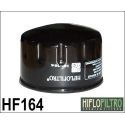
For individual models, we offer inspection kits for easy service (oil filter, air filter, sealing washer under the drain plug, spark plugs):
A brief discussion about motor oils in general..
Viscosity
Viscosity is a variable quantity that depends on temperature. During the operation of a car engine, among other things, there are changes in operating temperatures. For good lubrication efficiency, it is important that the viscosity of the oil changes as little as possible with temperature. This dependence is defined by the so-called viscosity index. The higher this index, the lower the dependence of viscosity on temperature changes. To characterize the viscosity properties of motor oils, specifications according to SAE (Society of Automotive Engineers, USA) are used. This standard uses 6 winter grades marked with a number and "W" (from English Winter) and 5 summer grades marked with a number.
Winter grades: 0W, 5W, 10W, 15W, 20W, 25W (-35°C,-30°C,-25°C,-20°C,-15°C,-10°C)
Summer grades: 20, 30, 40, 50, 60 (20°C, 30°C, 40°C, 50°C, 60°C)
The winter grade value determines the behavior of the oil at low temperatures (e.g. oil SAE 15W has a pour point of -25 °C).
The summer grade value determines the use of the oil at summer temperatures. If only one grade is used in the designation, it means that it is a single-grade oil (summer or winter). When a combination of summer and winter grade is used (e.g. 5W-40), it is a multi-grade oil or all-season oil. Currently, multi-grade motor oils are almost exclusively used.
Performance categories
Characterize immediate and long-term properties.and engine oils under various forms of operational load. Different properties are evaluated, such as oxidation stability, volatility, wear protection and deposits formation, corrosion protection, fuel efficiency, etc.
The following standards are used to designate the performance category of engine oils:
API classification (American Petroleum Institute, USA)
ACEA classification (Association des Constructeurs Européens d'Automobile, EU)
Corporate standards of engine and vehicle manufacturers (VW, MB, MAN, VOLVO, TATRA)
MIL-L classification (U.S. Army standards)
Other classifications (e.g., ILSAC)
Currently, the most significant specifications are API, ACEA, and corporate standards of engine and vehicle manufacturers. The CCMC classification is already outdated and is only mentioned temporarily.
API Classification
According to this standard, engine oils are distinguished by use into oils for spark-ignition (gasoline) engines, marked with the letter "S" (from English: Service) and for compression-ignition (diesel) engines, marked with the letter "C" (from English: Commercial). Most oils are suitable for both types of engines and are thus marked with a combination of both letters, e.g., SL/CF.
Performance Classes for Spark-Ignition Engines
SA - Oils without additives for engines operating under mild conditions with low load, produced in the years 1940 – 1950.
SB - Oils with additives to prevent deposits for engines produced in the years 1951 – 1963.
SC - Oils with additives to prevent deposits and low-temperature sludge for engines produced in the years 1964 – 1967.
SD - Additized oils with detergent and dispersant additives for engines produced in the years 1968 – 1971.
SE - Oils for highly stressed engines produced in the years 1971 – 1979.
SF - Oils for very heavily stressed engines produced in the years 1980 – 1988.
SG - Oils for engines produced in the years 1988 – 1993, which meet the strictest requirements for minimizing wear and deposits formation.
SH - Oils with the same properties as SG but tested according to more stringent standards. Intended for engines manufactured in 1996 and older.
SJ - Oil for engines produced in 2001 and older.
SL - Oils exceeding API SJ with increased fuel economy and possibility of extended oil change intervals.
SM - Oils of the highest quality exceeding API SL with increased oxidation stability, higher wear protection, and deposits resistance. Effective from 2004.
Oils for Spark-Ignition and Light-Duty Diesel Engines
A1/B1 - Oils with additives to prevent deposits on the piston, sludge formation, wear, and oxidation at high temperatures. They meet the requirements for super-light operation and fuel economy. They are suitable only for certain engines.
A3/B3 - Oils intended for highly stressed spark-ignition and diesel engines or for extended oil change intervals according to the engine manufacturer's recommendations.
A3/B4 - Oils for high-performance spark-ignition engines and diesel engines with direct fuel injection, also suitable for use described in category B3.
A5/B5 - Highly stable oils intended for extended oil change intervals in highly stressed spark-ignition and diesel engines. They meet the requirements for super-light operation and fuel economy. They are suitable only for specially designed engines.
Oils compatible with catalysts – for spark-ignition and light-duty diesel engines
C1 - Oils intended for use with DPF (diesel particulate filter) and TWC (three-way catalytic converter) catalysts in high-performance engines requiring low-viscosity oil with low SAPS (chemical limits) and with high temperature and high shear stress viscosity (HTHSV) greater than 2.9 mPa.s. These oils extend the life of catalysts and reduce fuel consumption. They are suitable only for specially designed engines.specially designed engines.
C2 - Oils for use with DPF and TWC catalysts in high-performance engines designed for low-viscosity oils with HTHSV greater than 2.9 mPa.s. These oils extend the lifespan of DPF and TWC catalysts and reduce fuel consumption. They are suitable only for specially designed engines.
C3 - Oils for use with DPF and TWC catalysts in high-performance engines. They extend the lifespan of DPF and TWC catalysts. They are suitable only for specially designed engines.
Oils for diesel engines of trucks
E2 - Common use oils for naturally aspirated and turbocharged engines, moderately to heavily loaded and with normal oil change intervals.
E4 - Oils providing excellent protection for cylinder cleanliness – against wear and soot. Recommended for high-performance engines meeting Euro 1, Euro 2, Euro 3 and Euro 4 emission limits, operating under heavy conditions, e.g., extended oil change intervals, as per manufacturer's recommendations. Suitable for engines without particulate filters and for some engines equipped with exhaust gas recirculation or SCR (Selective Catalytic Reduction of NOx) systems, according to the manufacturer's recommendations.
E6 - Oils providing excellent protection for cylinder cleanliness – against wear and soot. Recommended for high-performance engines meeting Euro 1, Euro 2, Euro 3 and Euro 4 emission limits, operating under heavy conditions, e.g., extended oil change intervals, as per manufacturer's recommendations. Suitable for engines equipped with exhaust gas recirculation with or without particulate filters and for engines with SCR systems. E6 - quality particularly recommended for engines with particulate filters and is qualified in combination with low-sulfur fuel (max. 50 ppm). Always follow the manufacturer's recommendations.
E7 - Oils providing effective protection for cleanliness and against cylinder polishing. They provide further improved protection against wear, deposits and soot. Recommended for high-performance engines meeting Euro 1, Euro 2, Euro 3 and Euro 4 emission limits, operating under heavy conditions, e.g., extended oil change intervals, as per manufacturer's recommendations. Suitable for engines without particulate filters and for most engines equipped with exhaust gas recirculation or SCR systems, according to the manufacturers' recommendations.
Note: Categories A2 and B2 are not included in the current edition. However, they are still valid in the latest version as long as car manufacturers recommend them in service books.
Categories E3 and E5 are replaced by categories E6 and E7.
Explanations:
DPF (Diesel Particulate Filter) - particulate filter
TWC (Three Way Catalyst) - three-way catalyst
EGR (Exhaust Gas Recirculation) - exhaust gas recirculation
SCR (Selective Catalytic Reduction) - selective catalytic reduction of NOx: treatment of exhaust gas composition with urea (AdBlue agent = 32.5% aqueous solution of urea)
Standards of car and engine manufacturers
Many car and engine manufacturers require motor oils to meet additional requirements that are not covered in the methodology of previous classifications.
How to properly choose motor oil?
1. The first principle when choosing motor oil is to follow the manufacturer's instructions contained in the manual for each vehicle. Only the engine (vehicle) manufacturer can responsibly say which oil can be used. Practically no manufacturer recommends a specific brand of oil (it contradicts the competition laws in the European Union). Manufacturers (of cars) recommend oils according to so-called performance specifications, e.g., API SH/CD, ACEA A3, VW 505.00, MB 229.1 and viscosity specifications SAE,for example 15W-40, 10W-40. For these recommended oils, the replacement intervals are specified.
2. For oils of the same performance specification, the same replacement interval is recommended.
3. If you do not have the vehicle manual, ask the manufacturer. Remember, the vehicle manufacturer does not recommend a brand of oil, only the performance and viscosity specification.
4. If the oil meets the performance and viscosity specifications (or a higher specification), it can be used. A higher performance level is acceptable, but it is usually more expensive and does not bring much benefit.
5. If you are changing oil of low performance specification (M5AD, M6AD) for a new high-performance oil, shorten the replacement interval for the first change (as deposits will be flushed out).
6. Do not mix mineral oils (SAE 15W-40, 15W-50, 20W-30, 40) with synthetic oils (SAE 0W and 5W-30, 40, 50).

Data sheet
Specific References

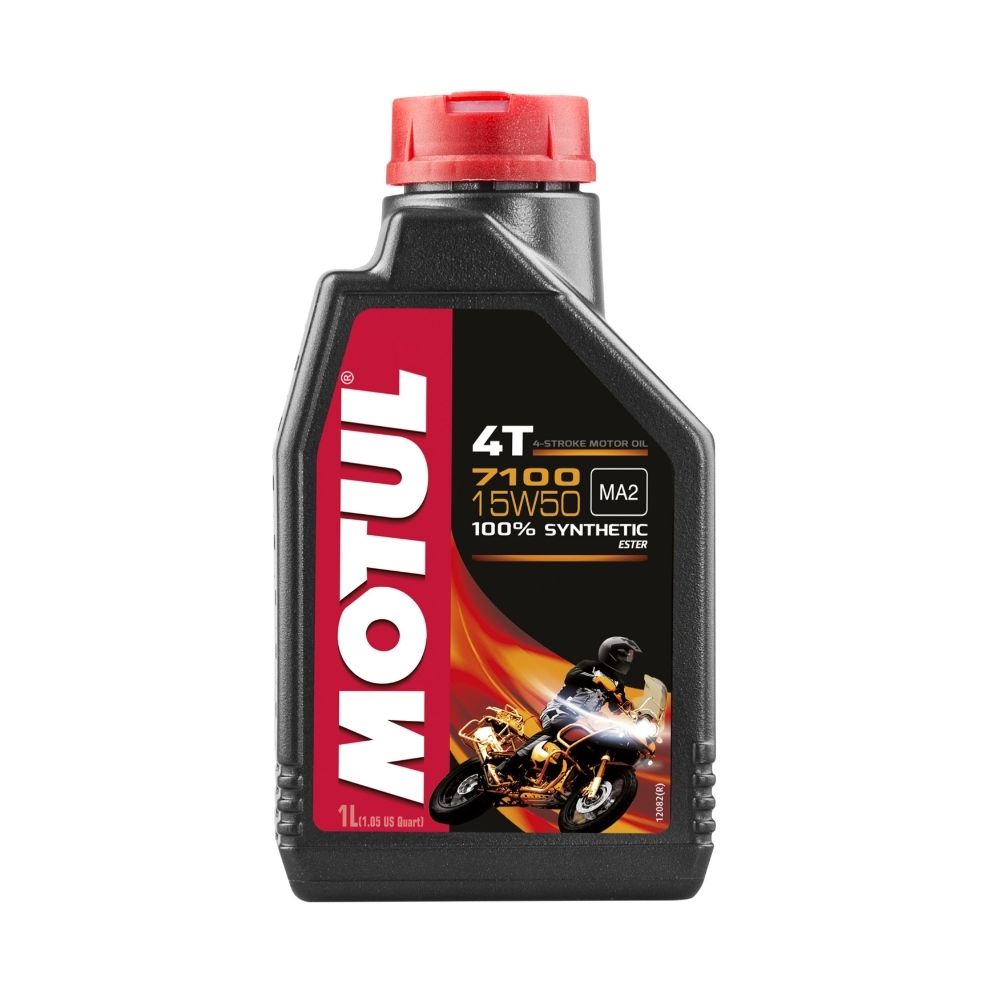
Motul 7100 15W-50 is a synthetic high-performance engine oil developed for air/oil cooled boxer engines - R1200GS 2004-2012, R1150GS, R1100GS.
suitable for:
R1200GS/A 2004-2012 (approx. 3.7l)
R1150GS/A 1999-2003 (approx. 3.7l)
R1100GS (approx. 3.7l)
F800GS/A, F700GS, F650GS Twin (approx. 3l)
F650GS/Dakar, G650GS (approx. 2.5l)


