





 Motorcycle
 On the road


 Apparel
 Secure Payments
Apple Pay, Google Pay, Credit Card or PayPal.
 Shipping to the EU for €5.99 or free on orders over €99.
Fast shipping via DHL (and partners). If in stock, 2–7 days across the EU.
 Need advice? Call us (English, Czech) or write to us (in your language).
+420 604 111 341 info@mojegs.cz
Video of the complete final drive service:
Times in the video for individual tasks:
1:15 - 2:20 disassembly of the fender, loosening of the filler bolt, loosening of the drain bolt - you will mainly need Torx of various sizes, all of which can be found in the Honiton set
3:30 - 6:40 disassembly of the wheel, brake caliper, lowering the final drive, disconnecting the shaft
6:54 - Castrol Optimol - lubrication of the splined shaft
8:06 - Staburags - bonding of the boot
8:50 connection of the shaft
10:40 returning the boot to the correct position (if damaged or worn out, replace it with a new one (rear boot for R1250GS/A, R1200GS/A LC 2013-2018, rear boot for R1200GS/A 2004-2012, rear boot for R1150GS/A, R1100GS))
11:00 - 13:20 reassembly of all components, including the specified torque settings - you will need a torque wrench
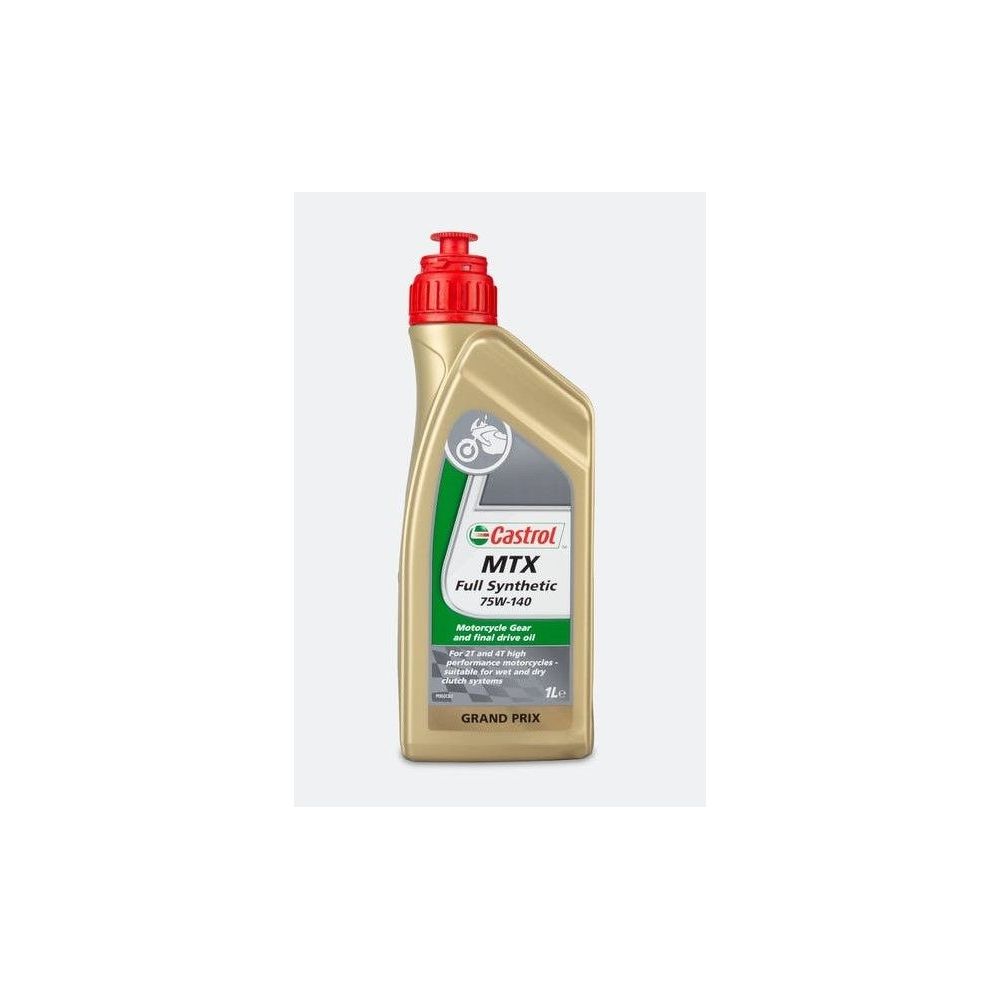
13:35 fill with 180ml of suitable oil (we recommend Castrol 75W-140, or Motorex Penta LC 75W-140 or original BMW Hypoid Axle Oil G3). For accurate filling, then use a syringe.
A short treatise on gear oils:
Gear oil specifications
Viscosity
For evaluating the viscous properties of gear oils, the SAE (Society of Automotive Engineers, USA) specification is used. This standard is used to classify oils into 4 winter classes, marked with a number and "W" (from English: Winter), and 5 summer classes marked with a number.
Winter classes: 70W, 75W, 80W, 85W
Summer classes: 80, 85, 90, 140, 250
If only one class is used in the designation, it means that the oil is monograde (summer or winter). When a combination of summer and winter classes is used (e.g. 80W-90), it is a multigrade oil or all-season oil. More often, unlike motor oils, manufacturers require monograde gear oils.
Performance categories
The performance category of gear oils is indicated by the API (American Petroleum Institute, USA) classification. The performance class designation consists of the letters "GL" (from English: Gear Lubricant) and a number indicating the performance level, of which there are six.
Currently, the following four performance classes are used:
GL-3 - low-additive oils for manually shifted transmissions with medium loads
GL-4 - highly additive oils primarily intended for manually shifted transmissions and lightly loaded hypoid gears
GL-5 - oils intended for heavily loaded hypoid gears, operating in the most demanding conditions

Data sheet
Specific References

Castrol MTX Synthetic 75W-140 transmission oil.


